Home | About | Services | Contact Lisa Libutti| Join us on Facebook

March 9, 2011

Learn How To Make Your Website Social

Should Your Site Be Social-Enabled?

There’s no doubt that social media is a powerful marketing and communication tool for businesses and non-profits that have embraced it.

Yet, for most of us, our websites are still where the rubber meets the road. It’s where you turn visitors into leads and prospects into customers. It’s where you build your lists and sell your goods.

Can you inject some of the “humanness” of social media into your website without compromising its ability to sell? Can you use social media to drive traffic to your website for conversion without alienating your community?

More and more businesses are showing us that this is an achievable and worthwhile goal; that the two together can foster improved communication, build brand loyalty and create a better, more responsive, more profitable company.

Here are nine examples of how you can integrate your social media activity into your website for maximum results.

#1: Add social media buttons to your home page

A few years ago, the idea of sending people to another site from your home page after you had worked so hard to get them there in the first place seemed boneheaded. However, many companies now see the long-term benefits of gaining a follower, fan or subscriber on a social media platform, even weighed against the short-term risk of sending them away from the website.
social media buttons
Businesses commonly link to their social media profiles, even from their home pages.
By getting someone to follow you on Twitter, become LinkedIn with you or subscribe to your YouTube channel, you have the opportunity to keep the lines of communication open long after they’ve left your website.

Unsolicited Advice: If you’re concerned about losing that prospect, consider having the site open in a new tab or window, keeping your own website available for later viewing.

Also, make sure you have a social media profile that will engage your audience. You can borrow ideas from these 10 top Facebook pages, read up on how to optimize your LinkedIn profile and put into practice Darren Rowse’s tips for improving your Twitter profile.

#2: Connect your blog with your website

The line between blog and website has never been blurrier, with many businesses choosing to build their entire site on platforms that were traditionally meant for blogging, such as WordPress.

Whether your blog shares a domain with your website or not, you can improve the interactivity of your website by teasing your blog posts from your home page.
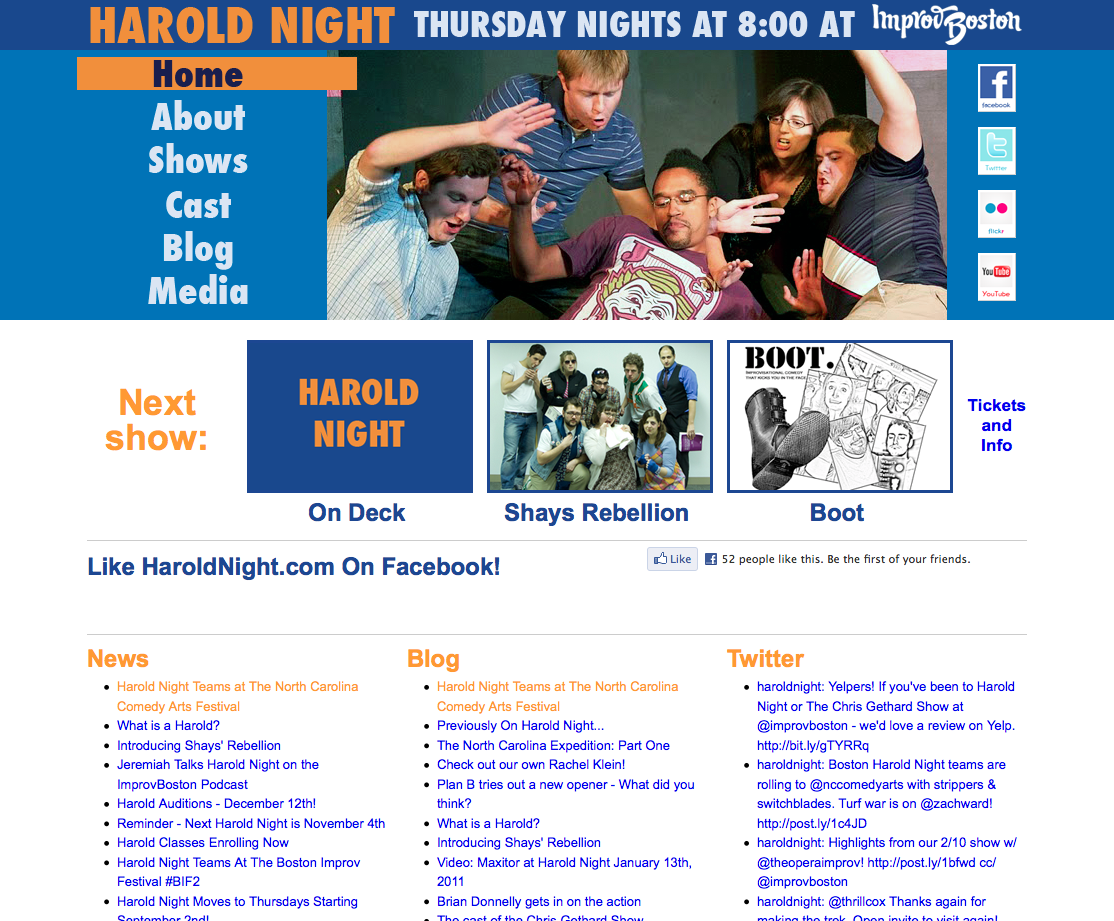
For example, Harold Night, an improv show out of Boston, uses the Posterous platform to blog, and has successfully integrated the blog into their website, both in the navigation and by pulling the recent posts as links onto their home page.

harold night
 

#3: Embed videos on your website

There are few things as engaging as a well put-together video. Imagine adding a how-to or explanatory video to your product or services pages… How much more compelling would they be? How much could you increase your conversion rates by showing examples of other customers finding success by using your products?
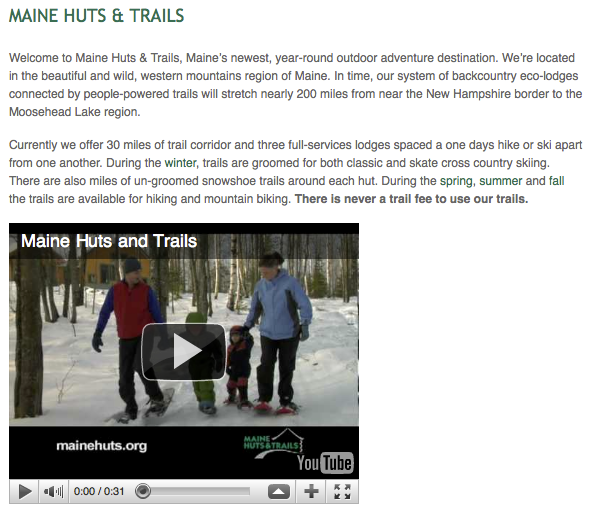
maine huts
Embed a video on your website to bring your offerings to life.

#4: Make your website shareable

Retweet buttons and Facebook Like buttons aren’t just for blogs. You can add them to any page of your website to get visitors to share the content more easily with their networks.

#5: Add your presentations to your website

If you market your business through public speaking, you can maximize your results by putting your presentations on your site.

The best way to do this is to set up a free account at SlideShare (think YouTube for PowerPoint). Once you’ve uploaded your slides, SlideShare will allow you to embed that presentation back into your website or blog. This creates an interactive experience for visitors who can now click through your slides.
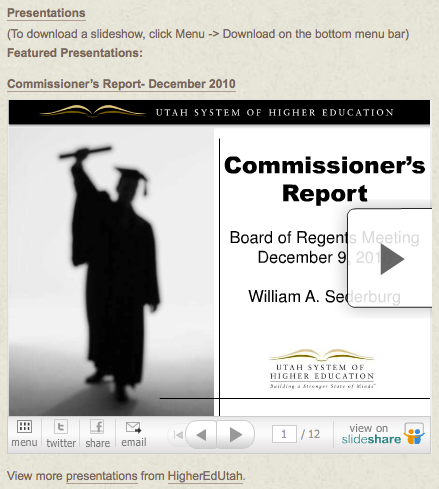
slideshare
Maximize the reach of your presentations by embedding SlideShare into your site.

#6: Socially bookmark new content

As you add new articles or archive your email newsletters to your site, make sure that you add them to appropriate social bookmarking sites like StumbleUpon, Reddit and Delicious. These popular sites can drive huge amounts of traffic to your website in a short period of time.

Unsolicited Advice: It’s always best when someone else bookmarks your content, so it might make sense to have a small “bookmarking club” with friends where you promote each other’s work. This “seeding” will often encourage others to bookmark your content.

#7: Add a Facebook Like box to your website
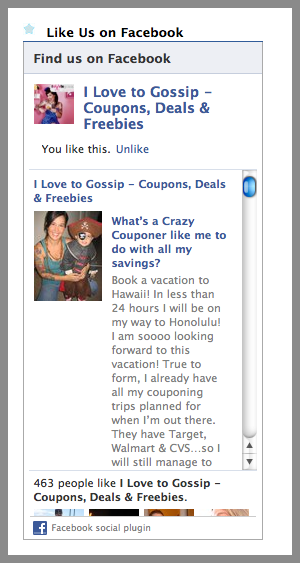
i love to gossip
It's easy to like I Love to Gossip with a Like box on their page.

We’re all influenced by other people, a concept often referred to as “social proof.” When we see our friends or people we respect liking, supporting or promoting something, we’re more open to liking it ourselves.
Adding a Facebook Like box to your site adds accelerant to the idea of social proof. Visitors can quickly see how many people have liked your business on Facebook, get a sense of your level of commitment to social media (by the posts you’ve added to your wall), and may even spy some of their friends and connections through the Like box.

Further, you make it easy for your site visitors to like your business without having to leave your site.
For more on Facebook and social proof, be sure to check out Are You Using Social Media as Social Proof?

#8: Feed your website

Websites tend not to get updated as often as they should be… something that has probably been exacerbated by the rise of blogging and social media.

If the framework of your website is fairly static, you can still keep it fresh by adding feeds from your blog, Facebook, Twitter and just about every social media platform that generates an RSS feed.

Unsolicited Advice: Not all of your feeds may be website-appropriate. Your tweets about American Idol, your love of bacon or thoughts on Sarah Palin may not be appropriate for first-time visitors to your website who are just looking for a reliable plumber or a trustworthy veterinarian (or whatever you may happen to be).

#9: Use QR codes to drive traffic
qr code

QR codes are two-dimensional bar codes that can be scanned by smartphones with cameras. Once scanned, they can redirect people to a website (among other tricks). Check out QR Code Marketing for Small Business and How QR Codes Can Grow Your Business.

Whether you post QR codes on one of your social media profiles or in the real world (i.e., direct mail, a business card or poster) you can use them to drive people to your website.

Unsolicited Advice: To maximize the impact of a QR code, consider sending people to a special landing page or a mobile version of your site, rather than just the home page. This will improve your conversion rates and help build your lists.

Now let’s hear about your ideas. This is by no means an exhaustive list. Let us know how you’ve integrated your social media activity into your website. Feel free to include links so we can see how you’ve done it. Leave your comments and suggestions in the box below.


Bookmark and Share

Article Source: on Social Media Examiner

Labels: , , , ,

February 15, 2011

Mindful Ways to Use Social Media


For the last two years, I have provided a daily wisdom quote through a Twitter account called Tiny Buddha. Since the follower count has grown by leaps and bounds, people have suggested I tweet more often throughout the day. I’ve realized, however, that the greatest lesson we can all learn is that less is enough. In a time when connections can seem like commodities and online interactions can become casually inauthentic, mindfulness is not just a matter of fostering increased awareness. It’s about relating meaningfully to other people and ourselves. With this goal in mind, I’ve compiled a list of 10 tips for using social media mindfully. 


1. Know your intentions.
Doug Firebaugh of SocialMediaBlogster.com has identified seven psychological needs we may be looking to meet when we log on: acknowledgment, attention, approval, appreciation, acclaim, assurance, and inclusion. Before you post, ask yourself: Am I looking to be seen or validated? Is there something more constructive I could do to meet that need?

2. Be your authentic self.
In the age of personal branding, most of us have a persona we’d like to develop or maintain. Ego-driven tweets focus on an agenda; authenticity communicates from the heart. Talk about the things that really matter to you. If you need advice or support, ask for it. It’s easier to be present when you’re being true to yourself.

3. If you propose to tweet, always ask yourself: Is it true? Is it necessary? Is it kind?
Sometimes we post thoughts without considering how they might impact our entire audience. It’s easy to forget how many friends are reading. Two hundred people make a crowd in person, but online that number can seem insignificant. Before you share, ask yourself: is there anyone this might harm?

4. Offer random tweets of kindness.
Every now and then I ask on Twitter, “Is there anything I can do to help or support you today?” It’s a simple way to use social media to give without expectations of anything in return. By reaching out to help a stranger, you create the possibility of connecting personally with followers you may have otherwise known only peripherally.

5. Experience now, share later.
It’s common to snap a picture with your phone and upload it to Facebook or email it to a friend. This overlaps the experience of being in a moment and sharing it. It also minimizes intimacy, since your entire audience joins your date or gathering in real time. Just as we aim to reduce our internal monologues to be present, we can do the same with our digital narration.

6. Be active, not reactive.
You may receive email updates whenever there is activity on one of your social media accounts, or you might have your cell phone set to give you these types of alerts. This forces you to decide many times throughout the day whether you want or need to respond. Another approach is to choose when to join the conversation, and to use your offline time to decide what value you have to offer.

7. Respond with your full attention.
People often share links without actually reading them, or comment on posts after only scanning them. If the greatest gift we can give someone is our attention, then social media allows us to be endlessly generous. We may not be able to reply to everyone, but responding thoughtfully when we can makes a difference.

8. Use mobile social media sparingly.
In 2009, Pew Research found that 43 percent of cell phone users access the Web on their devices several times a day. It’s what former Microsoft employee Linda Stone refers to as continuous partial attention—when you frequently sign on to be sure you don’t miss out anything. If you choose to limit your cell phone access, you may miss out online, but you won’t miss what’s in front of you.

9. Practice letting go.

It may feel unkind to disregard certain updates or tweets, but we need downtime to be kind to ourselves. Give yourself permission to let yesterday’s stream go. This way you won’t need to “catch up” on updates that have passed but instead can be part of today’s conversation.

10. Enjoy social media!
These are merely suggestions to feel present and purposeful when utilizing social media, but they aren’t hard-and-fast rules. Follow your own instincts and have fun with it. If you’re mindful when you’re disconnected from technology, you have all the tools you need to be mindful when you go online.

Article written by Lori Deschene is the founder of @TinyBuddha on Twitter and tinybuddha.com, a multi-author blog that features wisdom and stories from people all over the world.
Bookmark and Share

Labels: , , , , , ,

December 7, 2009

What is Social Media?

Social media is a phrase being tossed around a lot these days, but it can sometimes be difficult to answer the question of ... what EXACTLY is social media?

If Facebook and MySpace are social media sites, and Digg, reddit, and Newsvine are social media sites, and Wikipedia is a social media site, then just what is social media?

What is Social Media?

The best way to define social media is to break it down. Media is an instrument on communication, like a newspaper or a radio, so social media would be a social instrument of communication.

In Web 2.0 terms, this would be a website that doesn't JUST give you information, but interacts with you while giving you that information. This interaction can be as simple as asking for your comments or letting you vote on an article, or it can be more complex and can make recommendations based on the ratings of other people with similar interests.

Think of regular media as a one-way street where you can read a newspaper or listen to a report on television, but you have very limited ability to give your thoughts on the matter.

Social media is a two-way street that gives you the ability to communicate too.

What Are Some Social Media Websites?

Now that we have answered the question of what is social media, we can move on to social media websites. Because social media is such a broad term, it covers a large range of websites. But the one common link between these websites is that you are able to interact with the website and interact with other visitors.

Here are some examples of social media websites:
  • Social Bookmarking. (Del.icio.us, Blinklist, Simpy) Interact by tagging websites and searching through websites bookmarked by other people.
  • Social News. (Digg, Propeller, Reddit) Interact by voting for articles and commenting on them.
  • Social Networking. (Facebook, Hi5, Last.FM) Interact by adding friends, commenting on profiles, joining groups and having discussions.
  • Social Photo and Video Sharing. (YouTube, Flickr) Interact by sharing photos or videos and commenting on user submissions.
  • Wikis. (Wikipedia, Wikia) Interact by adding articles and editing existing articles.
And these websites are not the only social media websites. Any website that invites you to interact with the site and with other visitors falls into the definition of social media.

Related Aticle: What is Social Media All About?


Bookmark and Share

Labels: , , , ,

July 20, 2009

Time Management and Social Media

Ways you can make Facebook and Twitter work for you on the job

These days I'm asked frequently about the role of social media in personal and organizational productivity. The question is timely, as the major social media applications have millions of users and are still growing fast. Also, the phenomenon is closely tied to e-mail, which itself has presented major challenges to professionals in time management and keeping an appropriate focus in their work and life.

The most obvious issue about social media: Is this a useful way to spend your time, or is it a sinkhole of attractive distraction? It could very easily be one of those one minute, and the other the next! It all depends on why you're doing it, and this must be evaluated moment to moment. It's an important distinction to make for yourself, because focus is probably your greatest asset that you can control. You must be judicious about where you place it and what you let grab it, thus reducing your effectiveness.

Bear in mind that the most potentially productive activities (e.g. meetings) can undermine your control and focus if they're not carefully managed. And some pursuits that are commonly viewed as "time-wasting," such as random Web surfing or Facebook socializing can be productive, if you use that term in the broadest sense of achieving something you want.

Someone noticed that I was now on Twitter and said: "How can you be productive on Twitter?" My simple answer: "If I want to have Twittered, then it's productive!" I wasn't trying to be facetious. The truth is, if you're taking a vacation to relax and you don't relax, then it's an unproductive vacation.

Why would I (or anyone) want to "have Twittered," or be involved with any of the social media at all? There is inherently some sort of magic between the lines in much of it that seems to have struck a chord in so many of us. I attribute this to the transparency, connectedness, and immediacy that social media offer, which are key attributes of quality relationships--something humans crave at a basic level.

Looking at if from a more tactical, practical perspective, it seems there are three main reasons that it can serve people well:

You're an incorrigible extrovert, and you just love to schmooze.

If so, social media may be right up your alley. You simply need to be careful with balance, and whether your virtual social life is detracting from your physical one, or from your other responsibilities. You may need a prenuptial agreement that it's O.K. to disappear for hours away from your real-life partner to chat with people you'll never see. But if you're wired to get inspirational juice from multiple relationships in that way, it can be productive.

You have an agenda that is supported by this kind of connection.

If you need to know what's new and what's happening, moment to moment, social media can provide a competitive advantage. If you are building a global brand, as I am, and leveraging your personality and having a following is part of that strategy, playing in this arena is smart. I've only been on Twitter for a couple of weeks, but already it has invigorated lots of great discussions and a sense of connectedness with thousands of people in and around my network.

If having some sort of immediate communication from me helps reinforce the best practices that my methods represent for people's work and life, then there's lots of goodwill as well as good ideas spreading virally and quickly. Or, if you're in a business that excels with its "now-ness" in the market and culture, such as entertainment or consumer high tech, you'd better be on board. Or if you're out of a job, this hugely expanded Rolodex may be your best resource for your next opportunity.

You're researching.

You're intrigued, maybe a little intimidated by the early adopters and the popularity in the media about these media, and you're curious about what all this is about and want to find out whether and how you should engage. That's probably the majority of us, and I think there is still much to know about this world. You'll be in testing, trying-out mode. I'm still very much in this space, attempting to not miss out on whatever opportunities might lie waiting while at the same time not letting myself get too sidetracked along lines that start to require more energy than they deliver back.

It's not an easy call, because I've discovered that the proof is in the pudding. That is, I've got to participate in order to really know what's going to pay off and what isn't. The experience in Twitter was unexpected; and it took quite a bit of experimentation to get a feel for what was going on, and how to find a groove there.

The big key is to stay very clear about what your agreements with yourself are, relative to your engagement with such things as LinkedIn, MySpace, Twitter, and the like. The opportunity that the various social media offer is the ability to quickly communicate, collaborate, and get feedback from a large and previously inaccessible number of people, with varying degrees of filtering capabilities.

The challenge is that each of those social media involvements can represent another virtual in box, with an implicit assumption that you should think about and deal with what lands there. If "processing" those additional streams of input is simply a matter of scanning to see what's of interest to you, that may not take much time; and you can simply drop in and out on a whim. That's no different than channel surfing, other than the added seductiveness of interactive rabbit trails to pursue.

But if you are expected--by yourself or others--to be more familiar with the content, or to contribute and respond to content directly, you're going to have to be judicious in how you manage your social media commitments. It's not as innocuous as another cable station, unless you have specifically downgraded your expectations of how you're going to be involved.

Depending on your personal and professional interests, you can choose from the variety of social media the ones that fit for you. If the productivity best practice is to target your social media very precisely to attain your goals, then the productivity worst practice would be to indiscriminately hook into multiple sources of poorly defined static. To use social media effectively, just be sure that you aren't putting more effort in than the result you're getting.

By David Allen is the internationally bestselling author of Getting Things Done, Ready for Anything, and Making It All Work. He is the chairman and founder of the David Allen Company and is a leading authority on developing personal and organization capacity.


Labels: ,

January 6, 2009

The Year of Going Social 2009

For years, marketers have talked about 'listening' to the consumer. At the same time, Web 2.0 tools (social media and social networking tools) have been springing up all over the Internet. These social networking tools and widgets enable conversations to take place AMONG consumers. That conversation has evolved into video, picture, text, audio files ... and can be shared and passed on. This is what is called "viral marketing". Blogs, podcasts, YouTube, Twitter, Wikis, and social networks are the social media tools used to engage in conversation with one another. Clearly, a fundamental shift in the way we communicate has occurred. Welcome to the new world of "social media and social networking"!

Tap into the new world of social media marketing

The bad news for business? If you haven't tapped into the new world of social marketing ....You're late. The good news? You're not too late. It's true that many of the innovators and early adopters out there are screaming that you're going to be out of business if you don't hop on the social media bandwagon today. Not true.

If your doors are still open during the current economic conditions, you're doing something right! That said, your customers and clients are online communicating. Tapping into online social media gives you the opportunity to be a part of that conversation.

Social Media is a critical part of marketing

Fact is, most businesses haven't even thought about social media as a viable part of their marketing mix – until now. The adoption curve is a lot like the growth of websites in 1999. Do you remember when having a business Web site was novel, and then suddenly one day became critical? That's what's happening with Social Media. It's just beginning to hit the corporate radar screen as a part of an integrated marketing plan.

Social Media practitioners would be surprised at what's holding businesses back. Product managers and reputation management executives are worried about policy, privacy, and lack of control. They are puzzled by the openness and the transparency that is the currency of social media. Most of them don't even know what RSS feeds are or how to use them, let alone how to launch a blog.

"Customer Engagement" is the #1 reason to launch social media campaigns.

But, clearly, not everyone is an early adopter. Don't wait too long to get your feet wet and be prepared to catch up fast. Bottom line is that companies will be successful in 'going social' not because they were first, but because they're paying attention. Then, when no one is looking, they'll catch up fast, and could even take the lead.


By Beverly W. Macy and Troy A. Peterson, eMarketing Association Network Group

Labels: , , , ,